

By Andrew Gitner, Founding Educator at CoGrader & ELA Teacher · ~7 min read
Picture a Tuesday PLC. The math team pulls up a clean data wall: standards down the side, students across the top, green and yellow and red cells showing exactly who has mastered what. Ten minutes later they know which two standards to reteach and which students to pull for a small group.
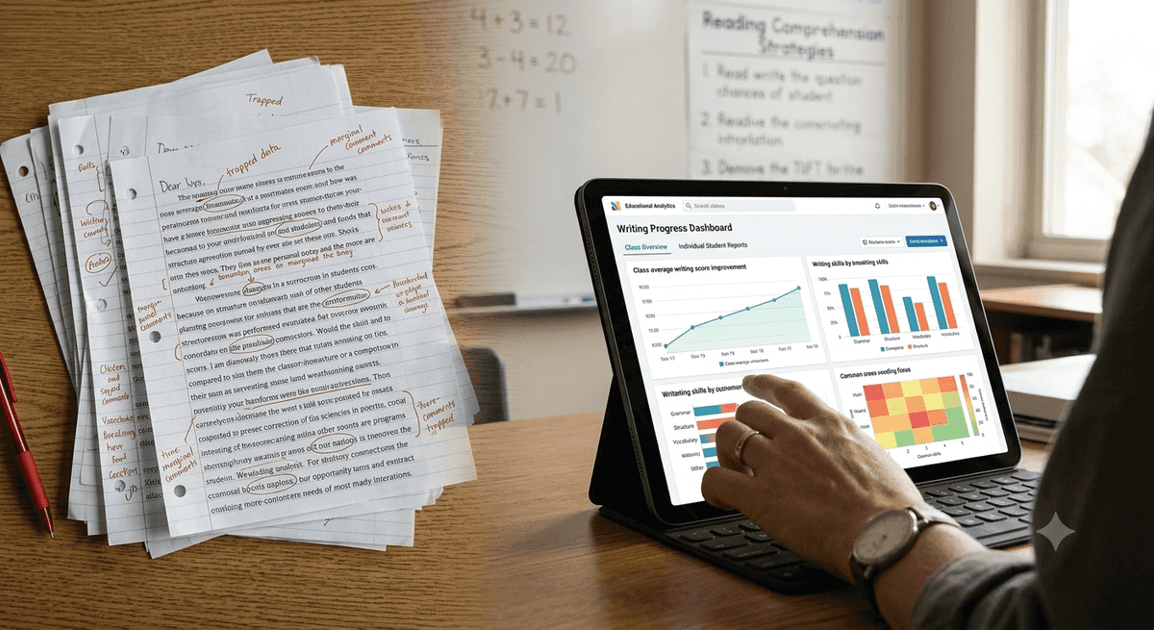
Next door, the English teacher has a stack of forty essays and a gut feeling. She knows her kids struggle with evidence. She thinks organization got better after the last unit. But she can’t prove it, she can’t show it on a wall, and she certainly can’t tell you which twelve students need a targeted lesson on integrating quotations by Thursday.
That’s the Writing Data Gap. Every other subject got the data revolution. Writing didn’t. And it’s worth understanding why, because the reason isn’t that writing resists measurement. The reason is that, until recently, nobody had the time to do the measuring.
What data-driven instruction actually means
Data-driven instruction, or DDI, gets over-complicated. At its core it’s the philosophy Paul Bambrick-Santoyo lays out in Driven by Data 2.0: schools should relentlessly focus on two questions. How do you know if your students are learning? And when they’re not, what do you do about it?
Notice what that isn’t. It isn’t more testing. It isn’t a new benchmark platform. It’s the loop between evidence and action. You gather clear evidence of where students are, you interpret it, and you change your teaching in response. Over fifteen years, schools that built their practice around this loop posted some of the largest achievement gains in the country.
The catch is that DDI depends entirely on getting usable data in the first place. In math, a ten-question exit ticket gives you clean, standard-by-standard evidence in minutes. Writing has never had that luxury.
If you’re an educator or leader who wants writing to be part of your data conversations, you can create a free CoGrader account or request a custom quote for your school or district today.
Why data-driven instruction is harder in writing
Writing data lives in the margins, not the gradebook
A single essay is one of the richest assessments a student produces. It contains evidence of a dozen distinct skills at once: thesis clarity, use of evidence, analysis, organization, sentence control, conventions. That’s a dozen data points per paper.
Then we collapse all of it into a single letter grade. A B-minus tells you almost nothing about what to teach next. The real data, the criterion-level detail that would actually drive instruction, gets written in the margins and handed back, never to be aggregated or analyzed again.
The volume problem, or the Measurability Trap
Here’s the uncomfortable truth: we manage what’s easy to measure, so writing gets measured least. Call it the Measurability Trap.
Analyzing writing at the standard level for 150 students, by hand, is functionally impossible on a human schedule. The numbers make the case. A 2024 RAND survey found that 60% of teachers report burnout and 84% say they don’t have enough time during work hours to do everything expected of them, with grading and feedback eating roughly five hours a week. Faced with that, teachers make a rational choice: assign less writing, or grade it faster and shallower. Either way, the data disappears.
Feedback that never closes the loop
Even when we do produce feedback, it often arrives too late to matter. John Hattie’s research pegs feedback at an effect size of 0.73, one of the single most powerful influences on achievement. But that number comes with a condition. Feedback only works when it’s timely and when students actually revise in response to it, what Edutopia calls the “Golden Second Opportunity”.
Feedback returned two weeks later, on a paper the student has emotionally moved on from, is a grade, not a coaching moment. Slow feedback breaks the DDI loop before it can close.
How CoGrader closes the writing data gap
CoGrader turns every essay into structured data.
Instead of one grade scrawled at the top, CoGrader scores a full class set against your rubric in minutes and breaks each essay down by criterion. You don’t just see that a student earned a B. You see they’re strong on organization, developing on evidence, and struggling on analysis, and you see it for every student at once.
That criterion-level detail is exactly the evidence DDI has always needed and writing never had. Class-wide and standards-level patterns surface automatically, so the weak spot that used to be a gut feeling becomes a chart you can act on. CoGrader supports the standards for all 50 states plus AP, IB, and Cambridge, so the data speaks the language your school already uses. (For more on aligning AI to your standards, see our Guide to Standards-Based Grading with AI.)
One thing that never changes: the teacher has final sign-off on every score. AI does the tedious first pass and surfaces the patterns. You make the professional judgment. There’s no bulk approval and no black box, and the platform is FERPA-compliant. Used this way, AI isn’t replacing the reader. It’s giving the reader time back.
What teachers and school leaders can do with it
For teachers: reteach from evidence, not instinct
Once writing produces real data, your instruction gets sharper. Spot the criterion where half the class is stuck and build tomorrow’s mini-lesson around it. Group students by the specific skill they need rather than by a vague sense of “the strugglers.” Return feedback fast enough that students can revise while the assignment is still alive. And, maybe best of all, assign more writing without drowning, because more practice is finally sustainable.
For leaders and PLCs: bring writing into the data conversation
For instructional coaches, department chairs, and administrators, the opportunity is bigger. Writing can finally sit in the same data conversations as math and reading. Departments can norm their rubrics against real student work, track writing growth across a semester or a year, and ground coaching in evidence instead of impressions. Equity conversations get sharper too, because you can see exactly which students aren’t getting the feedback and revision cycles that drive growth. That’s the kind of visibility that turns a writing feedback strategy into a measurable, school-wide practice.
Conclusion: Every writer deserves a coach
Ask most strong writers how they got good and you’ll hear about a person. A teacher, an editor, a mentor who read their work closely and coached them often. That kind of attention has always been the thing that makes writers, and it has always been the hardest thing to scale.
Data-driven instruction in writing is how we scale it. When every essay becomes usable evidence, and when feedback is fast enough to act on, close coaching stops being a privilege for the lucky few and becomes something every student can get. The Writing Data Gap was never about writing being unmeasurable. It was about time. And that’s a problem we can finally solve.
Try CoGrader for free → or request a custom quote for your school or district →
Key Takeaways (FAQ)
- What is data-driven writing instruction? It’s applying the DDI loop, gather evidence, interpret it, adjust teaching, to student writing, using criterion-level data instead of a single overall grade.
- Why is data-driven instruction harder for writing than for math or reading? A single essay holds a dozen skill data points that normally collapse into one grade, and analyzing that detail by hand for every student is impossibly time-consuming.
- Can AI do data-driven instruction in writing? AI can score a class set against your rubric in minutes and surface criterion- and standards-level patterns, giving teachers the evidence DDI needs. The teacher still interprets the data and makes instructional decisions.
- Does the teacher still control grades? Yes. With CoGrader the teacher has final sign-off on every score. AI handles the first pass; the human makes the call.
About the Author: Andrew Gitner, Founding Educator at CoGrader
Andrew is a leading voice in educational technology, AI, and writing instruction in Colorado. With over a decade of classroom experience teaching everything from AP Literature to Literacy Skills, he brings deep pedagogical expertise to his role. As an instructional leader, he has led district-wide redesigns of feedback and assessment practices in Jefferson County, CO, authored best-practice guides, and earned multiple educator fellowships from CEA and Teach Plus, and graded the Texas STAAR test, as well as the edTPA.
He is a Google Certified Champion who has presented to organizations like the Colorado Department of Education and the Colorado Education Initiative, has advised state and local school boards, and has worked on state-level policy to support educators. As CoGrader’s founding Teacher Lead, Andrew ensures our technology is grounded in sound pedagogy and authentically serves the needs of teachers and students. When he’s not thinking about the future of AI and writing feedback, Andrew enjoys playing disc golf and spending time with his family.