

Why Writing PLCs struggle (It’s Not Your Fault)
 Andrew Gitner
✨ Summary: "Escape the 'Measurability Trap' that undermines Writing PLCs. Learn how CoGrader's AI grading turns subjective debates into objective, data-driven instruction. Reduce grading bias and ensure equitable grading practices by using AI as a neutral third-party norming tool."
Table of Contents 📒
Why Your Writing PLC gets a Failing Grade (It’s Not Your Fault)
Series Note: This is Part 3 of our “Grading Paradox” series, inspired by a recent article from Edutopia. As we approach the midpoint of the year, we are exploring how AI can help you solve the biggest hurdles in grading—feedback, burnout, and bias—just in time to help your students grow this second semester.
If you’ve ever walked out of a Writing Professional Learning Community (PLC) meeting feeling like you just wasted an hour, you’re not alone.
I’ve lived the frustrated sighs. The circular arguments about whether a paper is a “3” or a “4.” Trying to agree on what “Analysis” looks like. The polite nodding while everyone secretly thinks, “This isn’t helping my students.”
It happens in schools everywhere. But here is the truth most educators miss: The problem isn’t your colleagues, your agenda, or the roles you assign in your meeting. The problem is the data.
When PLCs became the gold standard, they were modeled on subjects like Math—where data is objective, clear, and immediate (The “Measurability Trap”). Writing doesn’t work that way. It is messy, subjective, and prone to endless interpretation. When the “data” is a teacher’s own interpretation, their data becomes an extension of their professionalism, rather than a measurement of student performance.
This leads to what researchers call a “face-saving culture,” where teachers feel too vulnerable to share their real struggles because the grading feels so personal. Worse yet, there’s an implicit pressure to change your interpretation to match the needs of the PLC, rather than describe the needs of your students. This phenomenon morphs PLCs from the student-centered ideal to a system that saves face for adult.
To fix our PLCs, we need to fix the data. Here is how CoGrader turns subjective debates into data-driven instruction.
Read More: Stop Grading Writing, Start Teaching Writing: Level-Up Your Writing PLCs with CoGrader
1. The “Third Party” Norming Tool
Human grading is inherently unstable. We get tired (“Hangry Grading”). We have implicit biases. This makes “norming” meetings painful because they’re based on interpretation rather than reality.
- The CoGrader Solution: Bring CoGrader into your PLC as the objective “third party.”
- The Workflow:
- Have the department lead upload 5 sample essays to CoGrader.
- Review the AI’s scores together.
- Discuss why the AI flagged a thesis as weak.
- Result: The conversation shifts from “I think this is a good essay” to “Let’s look at the evidence the AI found.” It depersonalizes the critique and accelerates alignment.
Read Part 1 from our Grading Paradox series: Effective Student Feedback Strategies That Actually Work: How AI Fixes the “Grade Trap” | CoGrader
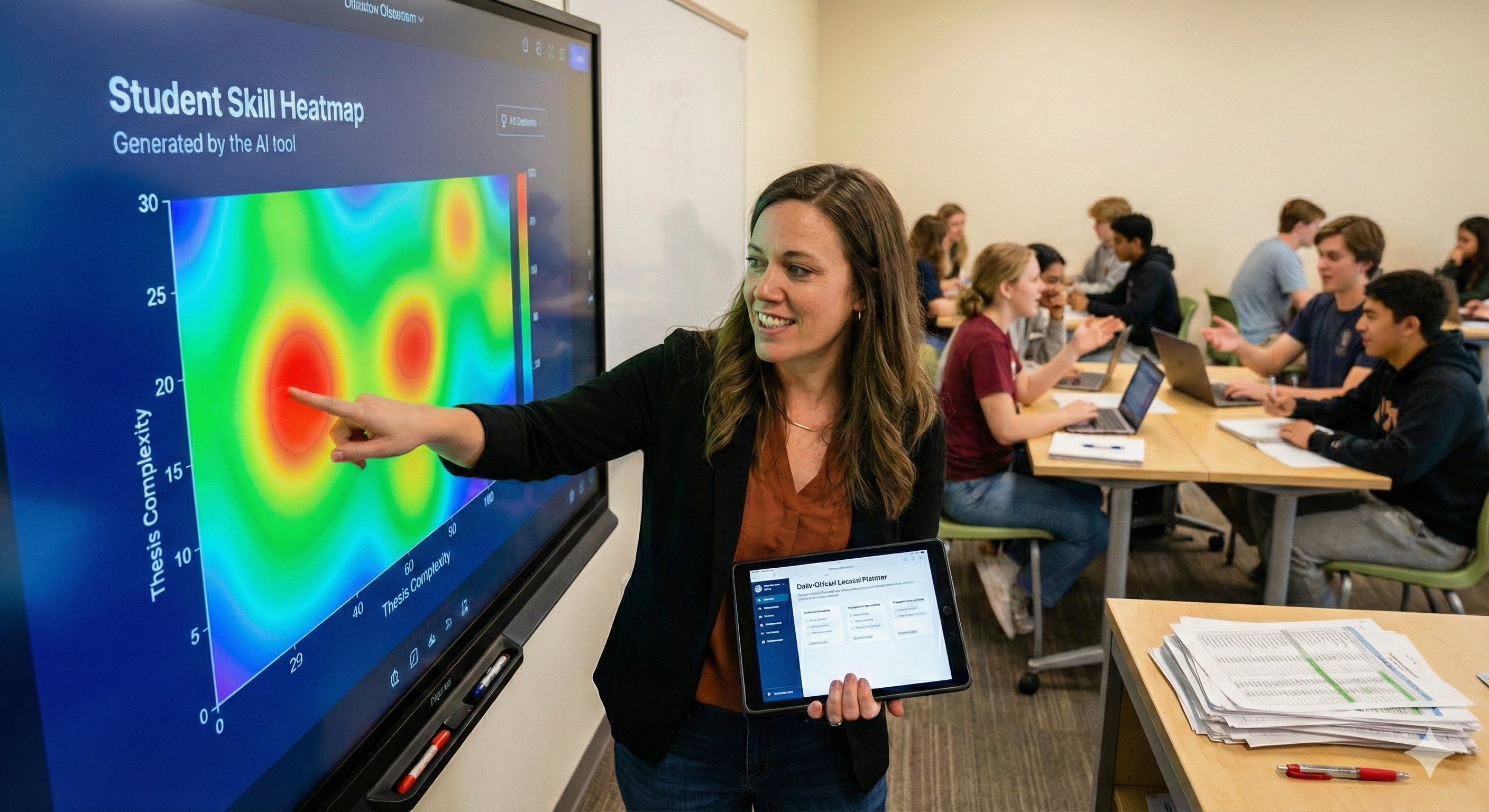
2. Moving From “Gut Feeling” to Heatmaps
In a typical Writing PLC, data analysis consists of saying, “I think they struggled with analysis.” That’s a hunch, not data.
- The CoGrader Solution: Class Analytics. CoGrader generates a “heatmap” of performance across your entire section or grade level.
- The Workflow:
- Look at the dashboard.
- See clearly that 80% of 9th graders scored highly on “Topic Sentences” but failed “Evidence Integration.”
- Action: The PLC decides to co-plan a mini-lesson on Evidence Integration for next week.
- Result: You are now planning instruction based on facts, not feelings.
3. Equity as a Default
We all have unconscious biases—favoring polite students, neat handwriting, or familiar names.
- The CoGrader Solution: By running a “bias check” with CoGrader, you ensure that every student is graded solely on the text they submitted. This isn’t about replacing the teacher; it’s about providing a guardrail that ensures fair grading practices for every student, every time.
Read Part 2 from our Grading Paradox Series: How to grade more writing, faster, and get your weekends back
Break free of the Measurability Trap
The “Measurability Trap” has held writing PLCs captive for too long, forcing educators into subjective debates instead of targeted, data-driven action. Your frustration is valid, but the solution isn’t to work harder; it’s to work smarter. By integrating CoGrader, you shift the focus from debating interpretations to analyzing objective facts. You depersonalize critique, align your instructional goals with precise class analytics, and, most importantly, guarantee fair grading practices for every student in your school.
Stop wasting time arguing about scores and start spending time planning instruction that truly moves the needle.
Ready to move your PLC from unproductive norming sessions to high-impact instructional planning?
Try CoGrader Free Today and Transform Your Writing Data
Key Takeaways (FAQ)
- How can AI help with PLC meetings? AI provides an objective baseline for grading, removing personal defensiveness and speeding up the “norming” process.
- Is AI grading fair? AI grading eliminates variables like handwriting bias, teacher fatigue, and “halo effects,” offering a consistent application of the rubric.
- What is the “Measurability Trap”? It is the struggle Writing PLCs face when trying to apply data analysis methods designed for Math to the subjective art of writing.
Read More: A New Playbook for Charter Writing Instruction
About the Author: Andrew, Founding Teacher at CoGrader
Andrew is a leading voice in educational technology, AI, and writing instruction in Colorado. With over a decade of classroom experience teaching everything from AP Literature to Literacy Skills, he brings deep pedagogical expertise to his role. As an instructional leader, he has led district-wide redesigns of feedback and assessment practices in Jefferson County, CO, authored best-practice guides, and earned multiple educator fellowships from CEA and Teach Plus, and graded the Texas STAAR test, as well as the edTPA.
He is a Google Certified Champion who has presented to organizations like the Colorado Department of Education on behalf of the Colorado Education Initiative, has advised state and local school board members on AI adoption, and has worked on state-level policy to support educators. He also holds a M.Ed in Instructional Design.
As CoGrader’s founding Teacher Lead, Andrew ensures our technology is grounded in sound pedagogy and authentically serves the needs of teachers and students. When he’s not thinking about the future of AI and writing feedback, Andrew enjoys playing disc golf and vibe-coding apps that can help his family.
Andrew Gitner
EdTech Specialist & High School ELA Teacher
Related content

IES Seedlings to Scale grant | CoGrader
CoGrader received an IES Seedlings to Scale grant to accelerate student writing proficiency through AI assisted personalized feedback at scale, with rigorous research and teacher partnership.


How to Use AI for Lesson Planning: Data Driven Instruction with CoGrader
Learn how to use AI for lesson planning to close skill gaps in real-time. Discover how AI assessment insights and ai lesson planning tools transform writing data into actionable next steps for your next unit.

Best Free Tools for Teachers in 2026 | A Practical Guide
Choose 10 Free software tools created for teachers to plan faster, engage more students, and reduce grading time in 2026.