
By Andrew Gitner, Founding Educator at CoGrader & ELA Teacher · ~6 min read
Data-driven instruction gets thrown around in PD sessions and staff meetings until it starts to mean everything and nothing. Here’s what the phrase actually means, where it comes from, and what it looks like once you point it at student writing.
Table of Contents
- What is data-driven instruction?
- The two questions at the heart of DDI
- The cycle: Assess, Analyze, Act, Culture
- What data-driven instruction is not
- The frameworks you’ll hear named
- What DDI looks like in a writing classroom
- Is your DDI actually working? A quick checklist
- Key Takeaways (FAQ)
What is data-driven instruction?
Data-driven instruction, or DDI, is the practice of gathering evidence of student learning, interpreting that evidence honestly, and adjusting instruction in response. It isn’t a program you buy or a dashboard you check once a quarter. It’s a loop between evidence and action, and for a writing classroom specifically, AI writing feedback and AI grading now make closing that loop realistic every week instead of once a semester.
If you’re building this loop into a PLC or a department, you can create a free CoGrader account or request a custom quote for your school or district.
The two questions at the heart of DDI
Strip away the acronyms and DDI comes down to two questions, laid out by Paul Bambrick-Santoyo in Driven by Data 2.0:
- How do you know if your students are learning?
- When they’re not, what do you do about it?
Notice what those questions don’t ask. They don’t ask how many benchmark tests you gave this year, or whether your data wall looks impressive. They ask whether you’re actually finding out what students know and doing something specific in response. Everything below is detail underneath those two questions.
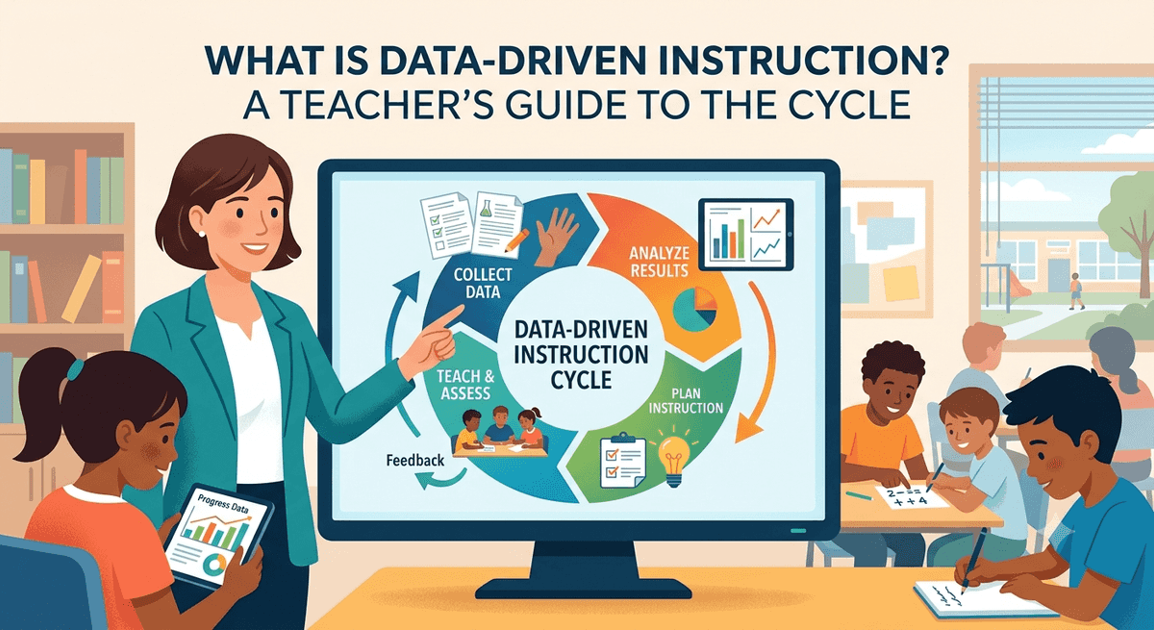
The cycle: Assess, Analyze, Act, Culture
Most versions of DDI describe some form of this cycle.
- Assess: Give students a task that surfaces what they currently know or can do, ideally something small enough to turn around quickly.
- Analyze: Look at the results at the standard or skill level, not just the overall score, and name the specific gap.
- Act: Teach directly to that gap, whether that means a whole-class reteach, a small group, or individual conferences.
- Culture: Build the habits and trust that make the first three steps sustainable: protected time, honest conversation about what isn’t working, and a norm of adjusting instead of blaming.
That fourth step gets left off a lot of summaries, but it’s the one that decides whether a team does this once a year or every week.
What data-driven instruction is not
A few things people mean when they say “data-driven” that aren’t actually DDI:
- More testing: Adding another benchmark doesn’t create a data-driven culture on its own. If nobody analyzes the results and changes instruction, it’s just more testing.
- A benchmark platform: Buying a dashboard is an infrastructure decision, not an instructional one. The dashboard can support the cycle above. It can’t replace it.
- Data walls for their own sake: A wall of color-coded names can motivate a staff, or it can just make struggling students visible to their peers. The wall isn’t the practice; what a team does with what’s on it is.
The frameworks you’ll hear named
If you sit in enough PD sessions, three names come up constantly. Here’s what each one actually adds.
Driven by Data: See It, Name It, Do It
Paul Bambrick-Santoyo’s model for a data meeting itself. Teams see the data by describing patterns without judgment, name the specific skill gap behind the numbers, then do something concrete about it before the meeting ends. It’s less a philosophy than a meeting protocol, and it’s the structure most schools end up borrowing.
Data Wise: Prepare, Inquire, Act
Harvard’s Data Wise Improvement Process breaks the work into eight steps across three phases: Prepare (organize for collaborative work, build assessment literacy), Inquire (dig into the data, examine instruction), and Act (plan, act, and assess again). Data Wise also names the “ACE Habits of Mind,” the disposition a team needs for the steps to actually work: being Assessment literate, Collaborative, and driven by Evidence.
DuFour’s four critical questions
Rick DuFour’s version isn’t specific to data meetings; it’s the foundation of the whole PLC model. Four questions that every team should be able to answer for their content: What do we want students to learn? How will we know they’ve learned it? What do we do when they haven’t? What do we do when they already have? DDI is really a close-up on the second and third of those four questions.
What DDI looks like in a writing classroom, and why it’s harder there
In math, a ten-question exit ticket gives you clean, standard-by-standard evidence in minutes. Writing has never had that luxury. A single essay holds a dozen skills at once, thesis, evidence, organization, conventions, and most of that detail collapses into one letter grade. The criterion-level evidence DDI actually needs gets written in the margins and never aggregated.
That’s the specific problem we dig into in The Writing Data Gap: DDI in writing requires analytic, criterion-level scoring, not a single holistic grade, and getting that by hand for a full class set has always taken hours nobody has. AI-assisted grading is what makes the cycle above realistic for writing on a weekly basis. If you’re building this into a PLC, our 45-minute writing PLC guide walks through exactly what that looks like in practice, and our guide to standards-based grading with AI covers getting the rubric right first.
Is your DDI actually working? A quick checklist
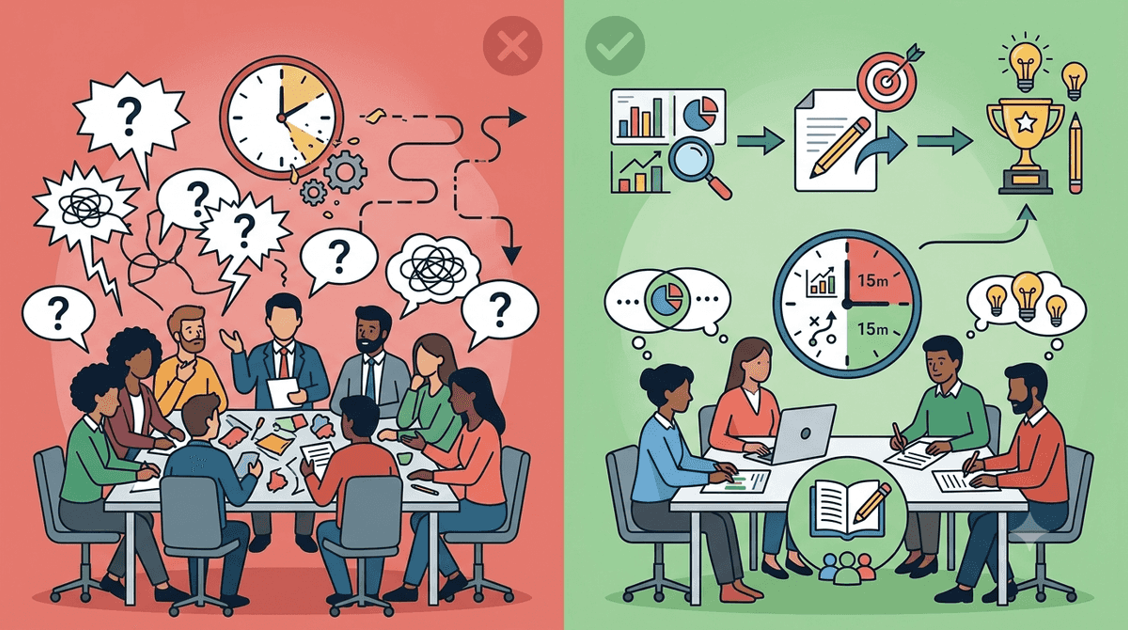
- Are you looking at data more often than once a quarter?
- Does your team name a specific skill gap, not just a vague impression (“they struggle with evidence”)?
- Does every data conversation end with a concrete instructional move and an owner?
- Do you revisit whether that move actually worked?
- Could a new teacher on your team describe your process in one sentence?
If most of those are “no,” you likely have data, but not data-driven instruction yet.
Key Takeaways (FAQ)
What is the DDI cycle? Assess, analyze, act, and build the culture that sustains it: gather evidence of learning, interpret it at the skill level, teach directly to the gap, and repeat often enough that it becomes routine.
What’s the difference between data-driven and data-informed? The terms get used interchangeably, but “data-informed” is sometimes used to signal that data is one input among several, alongside professional judgment, rather than the sole driver of a decision. In practice, most good DDI is also data-informed: the numbers point to a problem, and the teacher’s expertise decides what to do about it.
How often should you look at data? Weekly, for the assessments that matter most, is the cadence most PLC models are built around. Quarterly benchmark reviews have a place for tracking bigger trends, but they’re too slow to drive week-to-week instructional decisions.
Is DDI proven to work? Worth being honest here. The federal What Works Clearinghouse rates its own recommendations for using data to guide instruction at the “Minimal Evidence” tier, and large randomized studies of data initiatives have produced mixed results. What is well supported is the machinery underneath a good cycle: structured protocols improve the quality of teacher conversation, and targeted, timely feedback measurably improves student learning. DDI is a discipline for making sure that machinery gets used consistently, not a guaranteed score bump.
About the Author: Andrew Gitner, Founding Educator at CoGrader
Andrew is a leading voice in educational technology, AI, and writing instruction in Colorado. With over a decade of classroom experience teaching everything from AP Literature to Literacy Skills, he brings deep pedagogical expertise to his role. As an instructional leader, he has led district-wide redesigns of feedback and assessment practices in Jefferson County, CO, authored best-practice guides, and earned multiple educator fellowships from CEA and Teach Plus, and graded the Texas STAAR test, as well as the edTPA.
He is a Google Certified Champion who has presented to organizations like the Colorado Department of Education and the Colorado Education Initiative, has advised state and local school boards, and has worked on state-level policy to support educators. As CoGrader’s founding Teacher Lead, Andrew ensures our technology is grounded in sound pedagogy and authentically serves the needs of teachers and students. When he’s not thinking about the future of AI and writing feedback, Andrew enjoys playing disc golf and spending time with his family.